Services PG&E About Service Areas
🇲🇽 ES (408) 849-6200 david@apexbore.com
CROSS BORE
PG&E Cross Bore Inspections

PASSING THE PG&E
CROSS BORE TEAM.

Every PG&E bore that crosses a sewer or storm drain has to be proven clean on camera before PG&E signs off. Here's what the Cross Bore team looks for on gas and electric bores, what makes a video fail, and how Apex gets your job through it.

PG&E OQ Certified Contractor
Gas & Electric Cross Bore Paperwork
CCTV Coordination & Re-Camera
CSLB #838568 (A · B · Haz)
20+ Years Bay Area HDD
The Basics

WHAT IS A
CROSS BORE?

A cross bore happens when a new pipe or conduit installed by a trenchless method, like horizontal directional drilling, accidentally goes through another underground pipe instead of passing above or below it. The most common victim is a sewer lateral or storm drain. The new line can sit inside the sewer for years with nobody knowing, until the sewer backs up.

⚠️

Why It's So Dangerous

When a gas line runs through a sewer, a plumber clearing a "clog" with a cutting head or auger can cut straight into the gas line. Gas then travels through the sewer into the home. A 2002 cross bore incident in Minneapolis ended in a fire and explosion that destroyed two homes.

🔌

Electric Lines Too

An electric conduit bored through a sewer is a hidden hazard too: it blocks flow, and a drain cleaning tool can damage the conduit and the cable inside. That's why PG&E checks crossings on electric bores as well, not just gas.

📞

If You Hit an Obstruction

PG&E's own advice to plumbers: assume any sewer obstruction could be a cross bore. Stop work and call PG&E at 1-800-743-5000 before you clear it.

Who Reviews Your Job

PG&E'S CROSS
BORE TEAM.

PG&E started its Cross Bore Safety Program after a risk review of its gas system, and it has since grown into one of the largest programs in the country, with hundreds of thousands of sewer camera inspections completed. On new construction, the program works like this:

The contractor's CCTV company runs a camera through every sewer main, lateral and storm drain the bore crosses, records the video, and fills out the PG&E Cross Bore Inspection Log (form TD-4632P-01-F02). PG&E's Cross Bore team then watches the video. They have to be 100% sure that every crossed line is intact and nothing was bored through it. If they can't see it, they can't clear it, and the job doesn't close out.

What goes on the log

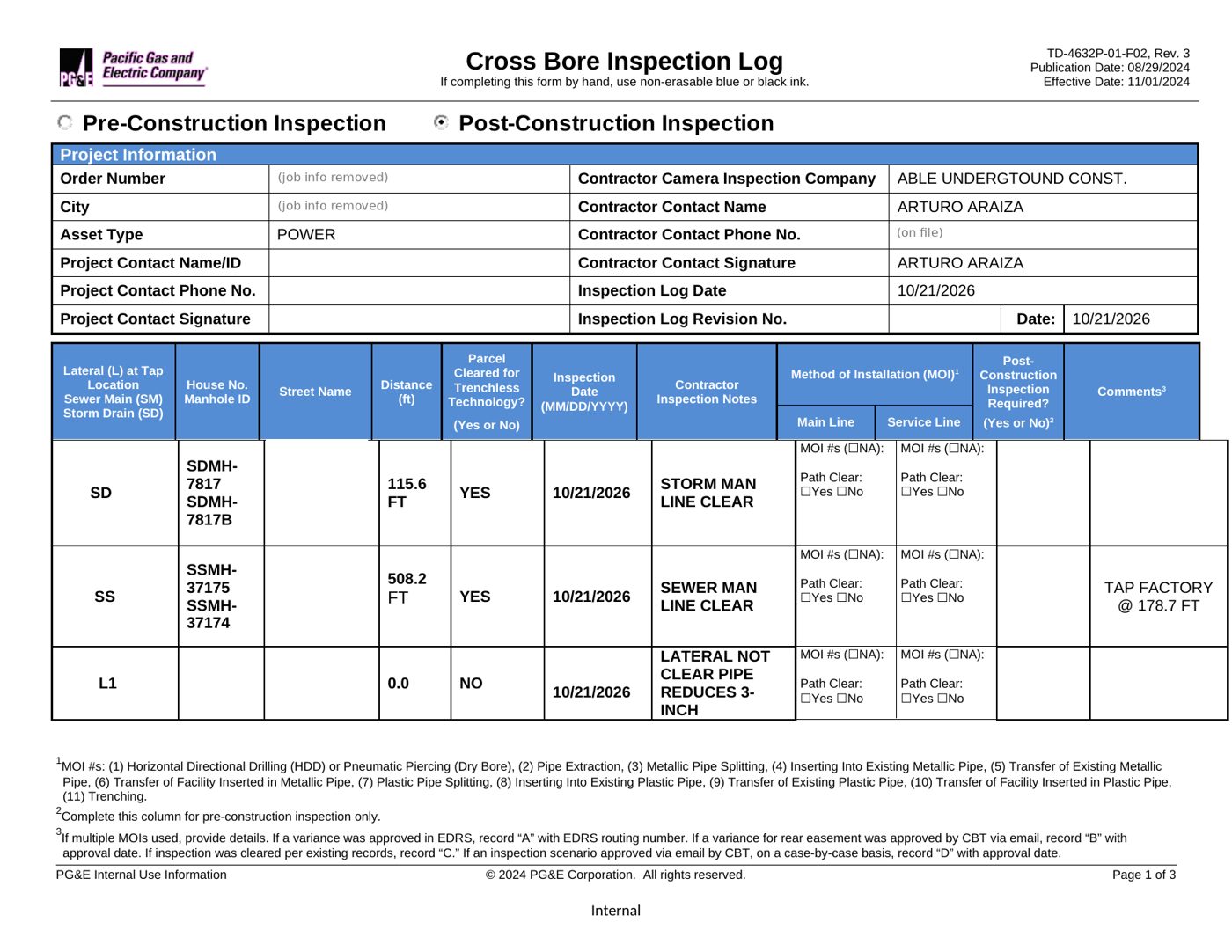
Each line crossed is listed with its manhole or house number, street, footage, the inspection date, the camera company's notes, and the method of installation. The log is marked as either a pre-construction or a post-construction inspection, and the PG&E PM number on the log has to match the job's construction drawing.

Requirements

GAS BORES VS.
ELECTRIC BORES.

Both need to prove the bore didn't damage anything it crossed. Gas bores carry the most scrutiny because of the explosion risk. Here's what we see on our PG&E jobs:

To Pass a Gas Bore

  • Sewer and storm lines along the bore path are located and identified before drilling (pre-construction), so the bore can be planned to clear them.
  • After the gas pipe is pulled in, every sewer main, lateral and storm drain the bore crossed is camera inspected (post-construction CCTV).
  • The video and the Cross Bore Inspection Log are submitted and reviewed by PG&E's Cross Bore team.
  • Every crossed line has to show a clear, complete view with no gas pipe inside and no new damage.
  • PG&E won't close out the job until the cross bore inspection is cleared, along with its other field inspections and the leak test.

To Pass an Electric Bore

  • PG&E's field inspector needs to see the conduit pulled into the bore.
  • Every utility crossing along the bore is checked for proper separation.
  • Where the bore crosses sewer or storm lines, post-construction CCTV and the Cross Bore Inspection Log are required, the same as a gas bore.
  • PG&E's Cross Bore team reviews the video before the job is cleared and the service is energized.
Where Jobs Get Stuck

WHY A CROSS BORE
VIDEO FAILS.

A failed video doesn't mean the bore hit anything. It means the Cross Bore team couldn't see enough to be 100% sure it didn't. Until they can, the inspection stays open. These are the most common reasons:

💧

Line Is Holding Water (Belly)

A sewer with a sag or "belly" holds standing water, and the camera can't see the bottom of the pipe through it. The Cross Bore team can't clear what's underwater, so the owner's line has to be repaired and then re-cameraed before the job can pass.

🪨

Mud, Gravel & Debris

Old sewer and storm lines are often full of mud, gravel or roots. If the camera can't get through, or the view is blocked, the video fails. The line has to be hydro-jetted or cleaned with a combo truck and then re-cameraed.

🚪

Laterals That Can't Be Reached

Some laterals can't be launched from the main because of a blockage or a size reduction. The camera crew then needs property access to a cleanout for a push camera from the house side.

📄

Paperwork Errors

A wrong PM number, missing manhole IDs, or a map that doesn't match the field can send a log back. Every line on the log has to match the drawing and the video.

What's In Our Price, And What Isn't

HYDRO JETTING &
RE-CAMERA ARE CHANGE ORDERS.

Many sewer and storm lines camera clean on the first run. Some don't, and nobody can know which ones until the camera goes in. That's why cleaning and re-camera work is never built into an Apex proposal. It's priced only if and when it's actually needed.

Hydro Jetting Is an Option, Not Included

  • Hydro jetting (high-pressure water cleaning, sometimes with a vacuum combo truck) is only needed when a line can't be cleared on camera because of mud, gravel, roots or debris.
  • Because it depends on the condition of someone else's existing line, it is never included in our proposal price.
  • If it's needed, we tell you which segments failed and why, and price the cleaning as a change order before any work is done.

Re-Camera After a Failed Line Is Extra

  • Our contract covers the post-construction CCTV of the lines our bore crosses, one time.
  • If a line fails because of its own condition (a belly holding water, debris, a blocked lateral, or no access to a cleanout), the re-camera is a change order.
  • Any repair the line needs, plus the hydro jetting to clean it and the re-camera to clear it, are all change orders and never part of our contract.

Why we do it this way

Building cleaning and re-camera costs into every bid would mean charging every client for a problem most jobs never have. Keeping them as change orders keeps your base price honest. You only pay for cleaning, repair and re-camera on the lines that actually need it, and you approve the cost before we do the work.

A Real Apex Job

WHAT A CROSS BORE
MAP & LOG LOOK LIKE.

On a recent PG&E electric service in the South Bay, Apex bored about 555 feet of 4" conduit along a city street, parallel to the sewer main and storm drain. The post-construction CCTV found a storm main packed with mud and debris and sewer laterals blocked with gravel, so those segments had to be cleaned and re-cameraed before the Cross Bore team could clear the job. Here are the map and log from that job, with the job site details removed.
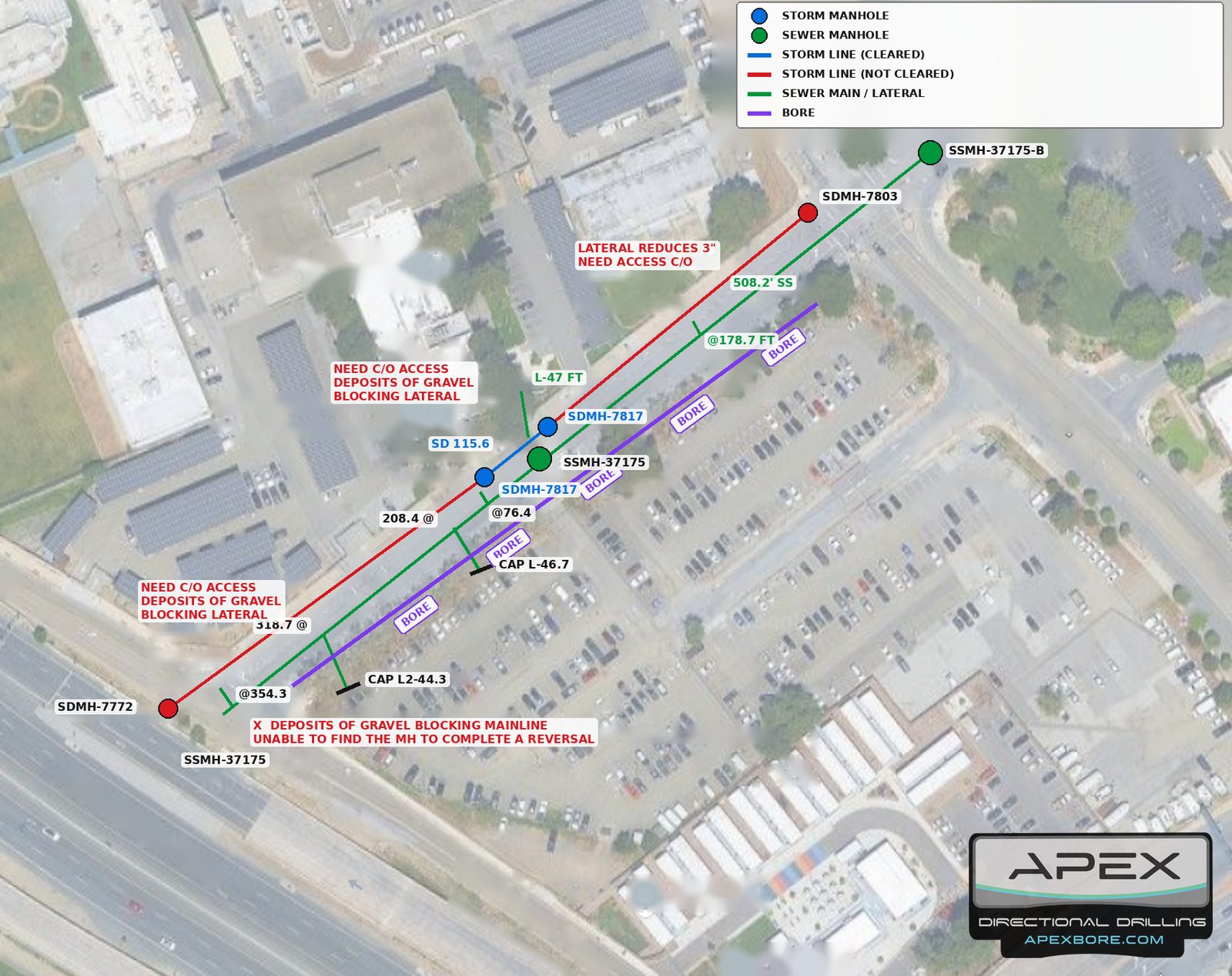
Example PG&E cross bore CCTV map for an HDD bore, showing the bore path, sewer main, storm drain, manholes and laterals
Cross bore CCTV map: the purple line is the bore, green is the sewer main and laterals, blue is the storm drain section that was cleared, and red is storm line that couldn't be cleared on the first camera run.
Example PG&E Cross Bore Inspection Log, form TD-4632P-01-F02, post-construction inspection
PG&E Cross Bore Inspection Log (TD-4632P-01-F02, Rev. 3), post-construction, page 1 of 3. Job site details and contact phone number removed.
How We Handle It

CROSS BORE DONE
RIGHT THE FIRST TIME.

01

Plan the Path

We review the PG&E drawing, sewer and storm records, and locates before drilling, and plan the bore to clear every gravity line.

02

Pothole Crossings

Crossing utilities are exposed so we can see depth and keep proper separation while drilling.

03

Track the Bore

The drill head is tracked the whole way, and depth and footage are recorded for the as-built.

04

Post-Bore CCTV

We coordinate the camera company to inspect every sewer and storm line the bore crossed.

05

Clean & Re-Camera

If a line is blocked with mud, gravel or debris, or is holding water, we tell you right away and price the hydro jetting, repair and re-camera as a change order for your approval.

06

Log & Closeout

We check the log, map and PM number against the drawing before submitting, so the Cross Bore team can clear the job without sending it back.

This page is a general guide based on PG&E's public cross bore safety information and our own experience on PG&E jobs. Exact requirements can vary by project, and PG&E's inspectors and Cross Bore team have the final say. Learn more on PG&E's sewer cleaning safety page.

CROSS BORE
PG&E Bore Coming Up?

LET'S GET IT
CLEARED.

Whether it's a gas service, an electric service, or a bore that's stuck in cross bore review, call Apex. We'll plan the bore around the sewer and storm lines, coordinate the CCTV, and handle the paperwork through closeout.